
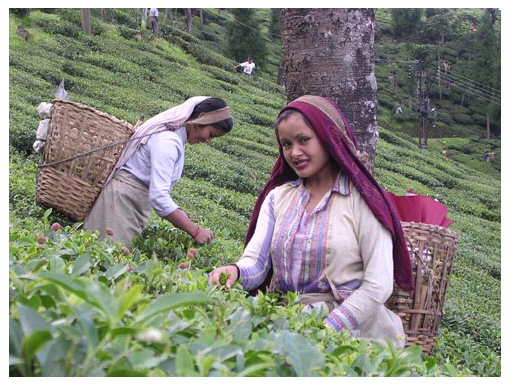
A Darjeeling tea garden – lush green! [Image source]
For once it’s not to sing paeans of the Queen of Hills. That it is so is beyond doubt, though the crowd makes a mess of the setting in the Darjeeling of today.
But if you brush aside your nosy feeling for a while, and especially if you care to take a ride down the Pankhabari Road instead of the usual Hill Cart Road, you’re bound to rejoice at the vast expanse of tea gardens, sharply undulating as far as eye can see.
For long, in absence of concerted move, the name Darjeeling tea has been every tea maker’s right to flout its magic, no matter if a tea is produced thousands of miles off from Darjeeling. Not surprising because for those who have tasted Darjeeling tea, the very mention of it sparks an immediate urge to partake some.
The good news is Darjeeling Tea has now been accorded a GI status in recognition of its being truly unique. What is a GI or Geographical Indication? Here is what it means (quoted from here):
Under international law, Geographical Indications mean indications which identify a product as originating in the territory of a member, or a region or a locality in that territory, where a given quality, reputation or other characteristic of the product is essentially attributable to its geographical origin.
Darjeeling tea is India’s treasured Geographical Indication and forms a very important part of India’s cultural and collective intellectual heritage.
Think cognac, a legendary drink, a class of brandy that is produced in the region surrounding Cognac, a French town. Like Darjeeling tea, Cognac brandy also carries a GI label because of its unique taste that no other brandy offers. Same is true for the other famous French brand, Champagne.
The mystery around Darjeeling tea is telling. Connoisseurs will tell you Darjeeling tea tastes different at different times. Here is an account (taken from today’s HT’s Brunch):
First flush – made just after winter – is astringent. Second flush – made from leaves plucked just before monsoon – has full-bodied ‘muscatel’ flavor. The monsoon tea is stronger, and the autumn tea is very delicate.
Be that as it may, what matters to Darjeeling tea lovers is its acquiring the just fame long overdue, and of course the sheer pleasure to take a sip out of it to the heart’s content. Darjeeling is unique, and so is the tea it produces.
Technorati Tags: darjeeling, darjeeling tea
Like this blog? Get daily posts by email.

Leave a Reply